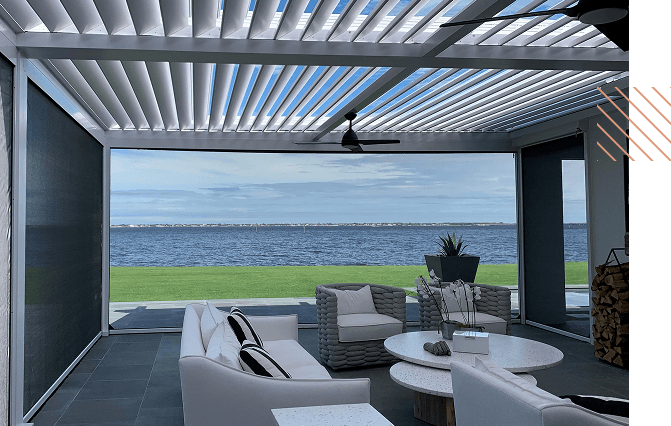
Your outdoor living space in Palm Harbor faces a relentless adversary that most shade manufacturers ignore: the Gulf of Mexico. Those afternoon thunderstorms rolling in from Tarpon Point don’t politely request entry—they arrive with 40-60 mph gusts that shred standard patio shades like tissue paper. If you’ve already replaced your exterior blinds twice this year, you understand exactly why wind-resistant outdoor shades aren’t a luxury here—they’re a baseline requirement for coastal living.
The problem isn’t your installation skills or bad luck. Standard outdoor shades are engineered for landlocked markets where a “windy day” means 15 mph breezes. In Palm Harbor, where the average annual wind speed reaches 8.5 mph with regular gusts exceeding 30 mph during storm season (Source: National Oceanic and Atmospheric Administration, 2023), those products fail by design. You need shade solutions built specifically for Gulf coast conditions.
Why Standard Outdoor Shades Fail in Palm Harbor’s Coastal Climate
The Gulf Breeze Engineering Gap
Most exterior shade products sold at big-box retailers carry wind ratings of 20-25 mph—adequate for Phoenix or Denver, catastrophically insufficient for your waterfront estate in East Lake Woodlands. When you’re enjoying evening views toward Fred Howard Park and a storm cell develops over the Gulf, those wind speeds can spike from calm to 50+ mph in under ten minutes.
Standard shade failure points include:
- Fabric tear-out at mounting grommets due to insufficient reinforcement
- Track derailment from inadequate side-channel depth
- Motor burnout from units fighting against wind load they weren’t designed to handle
- Frame buckling from thin-gauge aluminum that flexes under sustained pressure
According to the American Society of Civil Engineers, coastal structures within 3,000 feet of tidal water must meet enhanced wind load requirements—yet most residential shade products ignore these standards entirely (Source: ASCE 7-22 Minimum Design Loads, 2022).
Salt Air Corrosion Acceleration
Beyond wind, your shades in Palm Harbor battle invisible corrosion from salt-laden air. Standard powder-coated aluminum begins showing corrosion within 6-18 months of Gulf exposure. Homes near Wall Springs Park and throughout Curlew Creek experience accelerated degradation because prevailing winds carry salt spray directly inland. Marine-grade anodization adds 300-400% corrosion resistance compared to standard finishes (Source: Aluminum Association Technical Bulletin, 2021).
Coastal-Grade Shade Engineering: What Actually Works
Wind Load Specifications for Gulf Coast Installation
Truly wind-resistant outdoor shades for Palm Harbor applications require specific engineering characteristics that separate them from mainland-market products:
| Feature | Standard Shades | Coastal-Grade Shades |
|---|---|---|
| Wind Rating | 20-25 mph | 75-100+ mph |
| Track Depth | 1/2 inch | 1-1/4 inch minimum |
| Fabric Weight | 8-10 oz/sq yd | 14-18 oz/sq yd |
| Frame Gauge | 0.040 inch aluminum | 0.062+ inch aluminum |
| Warranty Coverage | 1-2 years, wind excluded | 5-10 years, wind included |
The deeper tracks prevent fabric blow-out during gusts by maintaining engagement even when wind creates negative pressure differentials across the shade surface. This isn’t marketing language—it’s physics applied to your poolside comfort.
Motorization and Wind Sensors for Automated Protection
Your Duke Energy Florida bill already reflects summer cooling costs averaging $150-200 monthly during peak season for typical Palm Harbor homes (Source: Duke Energy Florida Residential Rate Analysis, 2024). Windproof exterior blinds with integrated anemometers automatically retract when gusts exceed safe thresholds—protecting your investment while you’re away and ensuring they’re deployed when conditions permit energy-saving shade.
Smart integration features worth specifying include:
- Wind speed sensors calibrated for your specific installation height and exposure
- Rain detection to prevent water pooling damage
- Sun-tracking automation maximizing afternoon shade during peak UV hours
- Integration with existing smart home systems common in newer East Lake Woodlands construction
Pool Cage and Lanai Integration Challenges
Working Within Existing Enclosure Structures
Palm Harbor’s dominant architectural feature—the screened pool cage enclosure—creates unique installation requirements. Approximately 78% of homes with pools in Pinellas County have some form of screen enclosure (Source: Pinellas County Property Appraiser Database, 2023). Mounting coastal patio shades to these structures demands understanding their load-bearing limitations.
Your screen enclosure’s structural members were engineered to resist specific loads—adding shade systems without proper engineering analysis risks voiding your enclosure warranty or, worse, creating failure points during the next named storm. Professional assessment identifies:
- Load-bearing columns versus decorative elements
- Existing structural capacity versus required additions
- Optimal mounting points that distribute wind loads safely
- Integration methods that maintain your enclosure’s hurricane rating
Elevated Coastal Home Considerations
Homes built to current Florida Building Code in flood-prone areas near Tarpon Point often feature elevated first floors, creating additional wind exposure for outdoor living spaces. Wind speed increases approximately 10-15% for every 10 feet of elevation in open terrain (Source: Federal Emergency Management Agency P-55 Technical Manual, 2020). Your second-story lanai faces significantly higher wind loads than ground-level installations—a factor most shade quotes completely ignore.
Professional Insight: “We assess every Palm Harbor installation for actual wind exposure, not catalog assumptions. A shade rated for 75 mph at ground level may only handle 60 mph effective wind at your elevated deck height. That gap destroys systems—and customer trust.”
Gulf Coast Shade Solutions: Material and Design Selection
Fabric Technology for Humidity and UV Resistance
Palm Harbor’s subtropical humidity averaging 74% annual relative humidity creates conditions where standard shade fabrics develop mold within one season (Source: National Weather Service Tampa Bay Climate Data, 2023). Gulf coast shade solutions require solution-dyed acrylic or marine-grade vinyl-coated polyester with specific certifications:
- UV degradation resistance exceeding 1,500 hours accelerated weathering
- Mold and mildew resistance per AATCC Test Method 30
- Color fastness ratings of 4+ on the AATCC Grey Scale
- Breaking strength exceeding 300 lbs per inch for coastal wind ratings
Cheaper imported fabrics may look identical initially—your eyes can’t evaluate molecular structure. After one Palm Harbor summer, the difference becomes visually and structurally obvious.
Color Selection for Heat Reflection and Aesthetic Integration
Dark shade fabrics can reach surface temperatures exceeding 140°F under direct Florida sun, radiating heat into your living space rather than blocking it. Light-colored coastal-grade fabrics reflect up to 80% of solar radiation while darker options absorb and re-emit that energy (Source: Lawrence Berkeley National Laboratory Cool Surfaces Study, 2022). For homes throughout Curlew Creek where architectural covenants may influence color choices, neutral tones offer optimal performance without aesthetic compromise.
Installation Quality: The Hidden Variable
Why Installer Experience Determines System Longevity
A $4,000 coastal-grade shade system installed incorrectly performs worse than a $1,500 standard system installed properly. Critical installation factors specific to Palm Harbor conditions include:
- Substrate assessment: Stucco over concrete block behaves differently than stucco over frame construction—fastener selection must match
- Flashing integration: Preventing water intrusion at mounting points protects both your shade and your home’s envelope
- Electrical routing: Motorized systems require proper outdoor-rated conduit meeting Florida Building Code requirements
- Level and plumb precision: Out-of-level tracks create uneven fabric tension, accelerating wear and reducing wind resistance
Permitting and Code Compliance
Pinellas County requires permits for permanent exterior shade structures exceeding certain size thresholds. Unpermitted work creates liability during property sales and may void your homeowner’s insurance coverage during wind events—exactly when you need protection most. Professional installers manage permitting as part of your project scope, eliminating compliance headaches.
Making the Right Investment Decision
You’ve likely spent considerable resources creating your outdoor living space—the lanai furniture, the landscaping visible from Wall Springs Park walking trails, the outdoor kitchen that makes summer entertaining possible. Protecting that investment with properly engineered wind-resistant outdoor shades in Palm Harbor isn’t an expense—it’s preservation of value you’ve already created.
The true cost calculation considers replacement frequency, not just initial purchase price. Standard shades at $1,200 replaced every 18 months cost more over five years than coastal-grade systems at $3,500 lasting a decade with warranty coverage. Your time dealing with failures has value too—time better spent enjoying Fred Howard Park’s sunsets than shopping for replacement shade number four.
Request your coastal-grade shade assessment to receive site-specific wind exposure analysis, substrate evaluation, and honest recommendations for your Palm Harbor home. We’ll identify whether your existing structure can support the system you want or what modifications create the best long-term solution. Schedule your assessment today—before the next storm season tests whatever you’re currently using.
Frequently Asked Questions
What wind speed rating should outdoor shades have for Palm Harbor waterfront homes?
For true coastal protection in Palm Harbor, specify outdoor shades rated for minimum 75 mph sustained winds with gust tolerance to 100+ mph. Standard 20-25 mph rated products from big-box stores consistently fail during routine afternoon thunderstorms that produce 40-60 mph gusts multiple times weekly during summer months. Look for independent testing certification, not just manufacturer claims.
Can wind-resistant shades be mounted directly to existing pool cage enclosures?
Direct mounting to pool cage structures requires professional structural assessment first. Screen enclosures have specific load-bearing capacity limitations—attaching shade systems to decorative members rather than structural columns can cause enclosure failure during high winds. Qualified installers identify proper mounting points and may recommend independent support posts for larger shade spans to protect both your enclosure warranty and overall structural integrity.
How do automated wind sensors work on motorized outdoor shades?
Integrated anemometers continuously monitor wind speed at your installation location. When gusts exceed your programmed threshold—typically set 10-15 mph below the shade’s rated capacity for safety margin—the system automatically retracts. Once conditions stabilize for a preset duration, usually 15-30 minutes, the shades can redeploy automatically or await manual command depending on your preference settings. This protects your investment when you’re away from home during sudden Gulf storms.
What maintenance do coastal-grade outdoor shades require in humid Florida climates?
Quarterly cleaning with mild soap solution prevents salt accumulation that accelerates corrosion on hardware and stiffens fabric fibers. Inspect track channels for debris that could cause binding during operation. Lubricate guide cables or side retention systems annually with marine-grade silicone spray. Check motorized components for unusual sounds indicating bearing wear. Professional inspection every 2-3 years catches developing issues before they cause system failure during critical weather events.